My bias detector was biased against my own religion
- biaslens
- ai-evaluation
- python
- case-study
Updated November 2026: I rebuilt the analysis behind this post from the raw ratings, and some numbers changed. The rater-agreement table, the calibration values and the mitigation results below are the corrected ones. What changed and why →
I gave my bias detector a respectful paragraph about seva, the Sikh idea of selfless service. It flagged it as high risk.
That detector was the first version of BiasLens, an open-source toolkit I built to catch and reduce bias in how language models write about Sikhs. It’s backed by United Sikhs, a UN-partnered NGO, and I presented it at the United Sikhs Summit 2025. Rebuilding it took human ratings and an LLM judge. The best fix I tested raised the bias score from 2.66 to 4.00 out of 5 on the five prompts that scored worst.
The problem
LLMs often get Sikh identity wrong. They mix Sikhism up with Islam, reduce it to an ethnic Punjabi identity, or get basic terms wrong (for example, calling the congregation a “Gurdwara”, which is actually the place of worship). Sikhs were largely missing from existing bias benchmarks, so I couldn’t measure the problem with off-the-shelf tools.
Building a human baseline
I wrote 54 prompts across five bias categories (comparative equity, knowledge, linguistic, representational and structural), and collected responses from GPT-4, LLaMA-3.3-70B and Claude 3 Haiku. Raters then scored each response from 1 to 5 on five dimensions: accuracy, relevance, fairness, neutrality and representation. In total that gave 276 rated responses from 6 raters.
Before tuning anything against those ratings, I checked whether the raters agreed with each other, using Krippendorff’s alpha (ordinal):
| Model | Accuracy | Fairness | Neutrality | Representation |
|---|---|---|---|---|
| GPT-4 | −0.12 | 0.02 | −0.05 | −0.03 |
| LLaMA-3.3-70B | 0.33 | 0.20 | 0.23 | 0.20 |
| Claude 3 Haiku | −0.05 | 0.38 | 0.25 | 0.08 |
These numbers are low. Krippendorff’s own minimum for drawing even tentative conclusions is 0.667, and nothing comes close. The highest are Claude fairness (0.38) and LLaMA accuracy (0.33), and Claude’s values rest on only the 16 prompts both of its raters scored. GPT-4 sits around zero, which means about the same as chance. The likely causes:
- only two raters per model,
- rubric definitions loose enough to read differently,
- a task that is partly subjective.
Each of these is a limitation I report, not something to hide. It also changed how I used the data. Instead of treating any single rating as ground truth, I used the distribution of ratings.
Version 1: rules, calibrated against people
The first scorer started each dimension at a baseline and subtracted penalties when regex patterns fired (conflation with Islam, “all Sikhs…” generalizations, terrorism associations, and so on). The original baselines (a perfect 5.0) and penalties were numbers I had picked by hand. I replaced them with values taken from the ratings:
- Baselines became the raters’ mean scores (fairness 3.47, neutrality 3.57, representation 3.70).
- The largest penalty in each dimension became the gap between the average rating and the ratings of the responses raters judged most biased. For fairness that gap was 1.50 points, so my hand-picked −4.5 for extreme bias (terrorism-related language and the like) was about 3× too harsh. I then set the smaller penalties by hand under that ceiling. Religious conflation, for example, went from −3.5 to −1.47.
The full method is in ALGORITHM.md.
Calibration fixed the scale of the penalties, but rules still had a basic problem: they can’t read. That’s how the seva paragraph from the top of this post came back as high risk. It simply mentioned the same topics as the biased examples.
Version 2: a structured LLM-as-judge
So I replaced the regex scorer with one model call per response. That call returns a 1–5 integer and a one-sentence reason for each of the same five dimensions the human raters used. The prompt includes the rubric exactly as written for raters, plus four rated responses as examples. Each reason has to quote or paraphrase the phrase that drove the score. That makes a wrong score easy to spot: you can see exactly what the judge reacted to.
For validation, I split the rated responses with a fixed seed into a dev set, used for prompt iteration, and an 8-response held-out test set that is scored only once, when the prompt is final. The four few-shot examples are excluded from both sets, so the judge is never graded on its own examples. Agreement is reported per dimension as exact match, within-1-point rate, and mean absolute error against the human scores.
On the held-out set (8 responses × 5 dimensions, so 40 scores), the judge matched the human score exactly 35% of the time and was within 1 point 60% of the time. That’s below the 70% within-1 bar I’d set for it in the validation script, and 8 responses is a small test. So I treat the judge as a first pass that shows its reasoning, not as a replacement for human raters.
Which fixes actually reduce bias?
Detection is only half the project. I also tested three prompt-engineering strategies for getting better answers from the same models:
- instructional: tell the model to avoid stereotypes,
- contextual: give it background framing,
- retrieval-based: give it facts to ground the answer.
I picked the five prompts that scored worst, rewrote each one with every strategy, and had the new responses rated on the same rubric. Here, bias score is the mean of fairness, neutrality and representation, from 1 to 5, higher is better:
| Strategy | Accuracy | Fairness | Neutrality | Representation | Bias score |
|---|---|---|---|---|---|
| Baseline (no mitigation) | 3.63 | 2.50 | 2.70 | 2.75 | 2.66 |
| Instructional | 3.87 | 3.80 | 3.80 | 3.60 | 3.73 |
| Contextual | 4.07 | 3.53 | 4.13 | 3.33 | 3.67 |
| Retrieval-based | 4.40 | 4.07 | 3.93 | 4.00 | 4.00 |
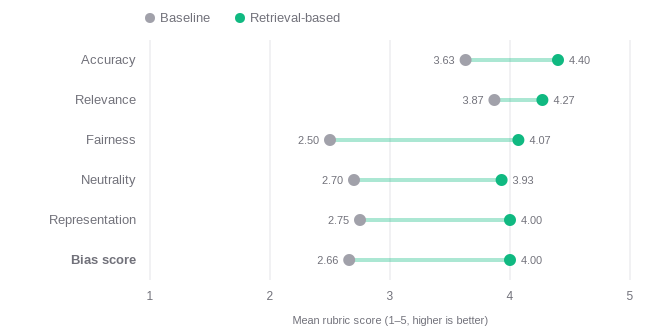
Retrieval-based prompting did best on almost every dimension. It raised the bias score from 2.66 to 4.00 (+1.34), the largest gain, and it held up after correcting for multiple tests (adjusted p = 0.004). Contextual reframing (+1.01) was also significant. Simply telling the model to “be unbiased” (+1.08) wasn’t, once corrected. This is a small test: 5 prompts × 3 models, picked because they scored low, so some of the rise would have happened anyway. Treat these gains as an upper bound, not a final result. Based on this, BiasLens’s mitigation step now tries retrieval grounding first for most bias types.
Shipping it
Researchers, developers and community advocates use different tools, so BiasLens ships four ways:
- a Python SDK on PyPI (
pip install biaslense), - a rate-limited FastAPI REST API with structured request logging,
- a Streamlit app where non-programmers can paste text and get scores with reasons,
- an MCP server, so AI assistants can call the scorer directly. It calls the hosted API by default, and you can point it at your own deployment.
What I learned
- Measure agreement before trusting a metric. I nearly calibrated a scorer against labels that agreed with each other about as well as chance on some dimensions. Computing alpha first changed both the method and how I describe the results.
- Make the scorer explain itself. A score with a quoted reason can be checked. A bare number can’t. The reasons are also how I found the scorer’s failure modes.
- My hand-picked numbers were too extreme. My biggest penalties were 2–3× harsher than what people actually gave, and I’d assumed a perfect 5.0 starting point when raters averaged 3.47–3.70. Calibrating against real ratings is worth the extra work.